


TSXV: SXL | OTCQB: SXLXF

The Moose Lake Antimony Project
Overview
he Moose Lake Antimony Project is an early-stage exploration property in the Bathurst Mining Camp of New Brunswick, Canada, optioned by SLAM in March 2026. It covers the historical Moose Lake, Stewart, and Skull antimony-gold showings (discovered in 1986) and is contiguous with SLAM’s wholly-owned Slacks Lake claims. Combined, the land package totals approximately 3,567–3,895 hectares of road-accessible ground underlain by volcano-sedimentary rocks.

Multi-Metal Potential (Antimony + Gold-Silver)
Beyond pure antimony, the system shows clear precious-metal endowment. At the Skull zone, 2026 trenches traced a silicified breccia over 242 m (8 trenches). Grab samples returned three >1% Sb (assays pending for exact grades), while separate samples returned up to 1.965 g/t Au / 39.6 g/t Ag and 1.09 g/t Au / 73.5 g/t Ag, indicating a distinct gold-silver zone alongside the antimony mineralization. Historic work already noted Au with Sb. This dual (or triple) commodity profile improves project economics and investability, especially given antimony’s status as a critical mineral and gold/silver’s liquidity and price support.
Mineralization is primarily epithermal-style silicified breccias and quartz veining with stibnite (antimony), plus associated gold and silver, controlled by the regional Moose Lake fault. Historic grab samples reached up to 4.32% Sb and 0.894 g/t Au (Skull), 1.67% Sb and 0.16 g/t Au (Moose Lake), and lower values at Stewart. Recent 2026 trenching has confirmed high-grade antimony (multiple samples >1% Sb, final assays pending) and a parallel gold-silver zone (up to 1.965 g/t Au and 73.5 g/t Ag).
Scale and Continuity Along a Regional Structure
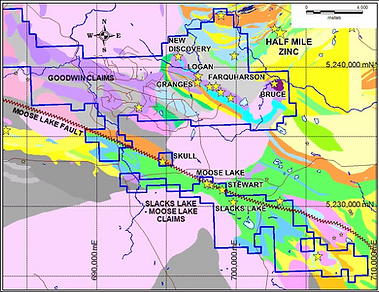
All three historic showings (Skull, Moose Lake ~3.7–3.8 km SE, Stewart farther SE) lie along the Moose Lake fault. Historic work at Skull outlined ~120 m strike × 20 m width × 120 m depth; Moose Lake was traced ~285–300 m by trenches/drilling (open in all directions); 1988 drilling confirmed epithermal breccia in three holes. SLAM’s 2026 work extended the Skull breccia to 242 m. Contiguous Slacks Lake claims host additional antimony till anomalies along the related Moose Brook fault, providing untested strike potential.
The project is fully road-accessible in a established mining camp (Bathurst) with nearby infrastructure, power, and skilled labor. New Brunswick offers a stable, mining-friendly Canadian jurisdiction with relatively straightforward permitting for early stage work.
Mineralization remains open along strike and at depth. SLAM has already completed initial trenching at Skull and moved the excavator to the Moose Lake zone; 36 samples were collected overall, with more assays pending. Future programs can target extensions, the till anomalies on Slacks Lake, and deeper drilling of the known breccia systems.